
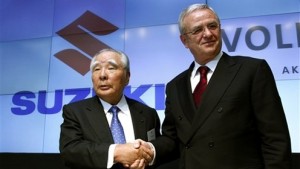
 Suzuki Japanese company decided to end the alliance with the German group Volkswagen and the “divorce” is added to a growing list of failed cooperation in the automotive industry, raising doubts about their profitability, writes Reuters.
“Transcontinental partnerships are extremely difficult”, said Thomas Sedran, CEO of consulting company AlixPartners. He noted that these projects need more time to bear fruit.
“A project that requires 30 months to be completed in Germany and Central Europe could take 40 months in other regions”, said Sedran.
The most spectacular failure was that of Daimler, four years ago, when it dropped Chrysler and “swallowed” the loss of 30 billion dollars.
PSA Peugeot Citroen and Mitsubishi Motors, which are working together on projects such as electric cars, tried to exchange shares to cement their partnership, but talks were abandoned last year.
Even in Europe a number of collaborations have failed
An important alliance, involving cross-holdings of shares between Renault and Volvo, was broken in 1994 after a revolt of shareholders of the Swedish company.
More recently, BMW sold Rover, after six years of ownership of the British company led to massive losses.
Under intense pressure to reduce costs, smaller car manufacturers tried to develop or expand alliances that give them access to the types of models that are not part of their portfolio, or to new markets.
For smaller manufacturers such as Suzuki Motor, the independent development of complex technologies such as hybrid systems is not an option. This was why the Japanese company has teamed up with VW in 2009.
But Suzuki announced Monday that it wants to end the alliance, after the German group has accused it of violating the pact by an agreement with Fiat on diesel engines supply.
The break up occurred after two months of wrangling, in which Suzuki has accused VW that wants to bring under its control the Japanese manufacturer.
Alliance failure highlights the difficulties addressed by car manufacturers to remain on good terms and is a new blow to VW, less than a week after it had to postpone next year’s merger with Porsche.
“Volkswagen is struggling in isolation,” said Ferdinand Dudenhoeffer, head of the Center for Research in Euro domain at the German University of Duisburg-Essen.
VW wants to surpass Toyota to become the largest automaker in the world until 2018, but some analysts say that the ambition of the group’s president, Ferdinand Piech, to build an auto empire has made suspicious the other producers, due to the aggressive expansion strategy.
The German auto manufacturer, the largest in Europe, is involved in several mergers and acquisition projects, including the merger agreement with Porsche and production plan to merge Scania and MAN trucks.