
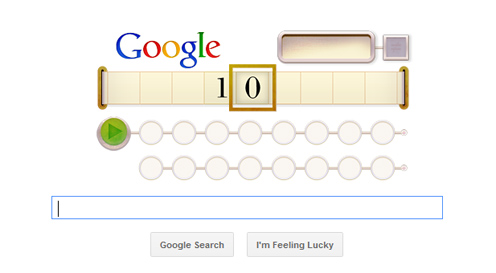
 International scientific community celebrated on Saturday the centenary of the birth of the father of modern computing, British Alan Turing, the scientist who managed, among others, to decipher secret codes used by Nazis during the Second World War. Today’s Google logo is a representation of the “Turing device”, a system that led to the modern computer. This device was reading a series of “one” and “zero” digits from a tape, describing tasks to be undertaken. Saturday we celebrate 100 years since the birth of the scientist, who was considered the Einstein of mathematics, but was persecuted in life because he was gay.
“Alan Turing is undoubtedly the only person who had major contributions that have changed the world, in the finest three types of intelligence: human, artificial and military,” said the editors of Nature in a recent editorial. Alan Turing died at age 41, on June 7, 1954, by cyanide poisoning after being convicted in 1952 for “gross indecency” because of his homosexuality, then illegal in Britain, and constrained to chemical castration. There are few voices who said that the scientist, famous for his eccentricity, was killed after eating an apple poisoned with cyanide. This hypothesis has never been formally proven.
Alan Turing laid the foundations of modern computer science, has defined the criteria for artificial intelligence and deciphered the codes used by the German army, which, according to many historians, would have saved millions of lives by shortening the war, and was very close to solve a biological enigma scientists today are passionate about. In 1936, Alan Turing, who said that he wanted to “build a brain”, published an article described the “universal Turing machine”. He was thus the first scientist who wanted to create programs for a machine, in the form of data, which allowed it to perform multiple tasks simultaneously, as computers do today. When his machine was actually built by other scientists in 1950, the first version of the Automatic Computing Engine (ACE) created by Turing was the fastest computer in the world.
For the general public, the most successful Turing achievement indeed remains the “breaking” of codes used by the Enigma machine, used by German submarines in the North Atlantic to communicate with each other. Some historians believe that this achievement hastened the fall of Adolf Hitler, who otherwise would have survived in power for another year or two.
After World War II, Turing explored the field of artificial intelligence, and defined the logical criteria which are still in force today, devising the famous “Turing test”, which is based on a machine’s ability to sustain a conversation. In other words, a computer is really smart only when people can no longer tell the difference between the answers given by the machine and those offered by a human being.
Biology was another passion of Turing – he has used his mathematics talent in the morphogenesis, trying to figure out why animals and plants have developed certain models in terms of shape or color – such as zebra stripes or spots on dairy cows – theories that are still a concern to this day for scientists.

Reply