
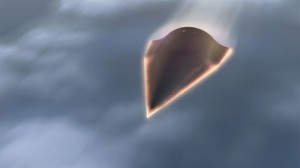
 An experimental unmanned aircraft that can reach a speed of 13,000 miles per hour, will be tested on Thursday. Falcon HTV-2 will be launched into space aboard a rocket, then will return to Earth.
The previous test flight lasted only nine minutes, and the aircraft was destroyed intentionally, as a safety measure because of technical difficulties, reports dailymail.co.uk.
If weather allows, the rocket that will carry the aircraft into space will take off from Vandenberg Air Force Base in California. Once in space, the plane will separate from rocket and will descend to Earth at a tremendous speed. The flight between New York and Los Angeles, which normally takes five hours, may be covered by this aircraft in just 12 minutes.
The project is made by the Pentagon and Defense Advanced Research Projects Agency (DARPA) and is part of a generation of hypersonic weapons that can strike faster than rockets. U.S. Army hopes that these aircraft will eliminate potential terrorists from all over the world in less than an hour.
Dave Neyland, director of the Office DARPA, said that the institution wants to work on more technical data to support the development of supersonic technology.
“We gained valuable data from the first flight, we made some changes to improve the plane and now we are ready to test it”, said Dave Neyland.
During the first flight of the Falcon, data was collected on aerodynamics, navigation, and how the heat affects the airplane. Engineers have not found the exact reason of failure of the first flight, which took place in April last year, but there has been speculation that the plane was too hot.
Plane idea began to take shape in 2003 in a research project aimed at building a military plane that can reach, with bombs on board, any point on the globe in less than an hour.
The aircraft was tested in wind tunnels, but they can simulate speeds up to Mach 15 (over 11,300 miles/hour). A real test is the only way to find out if the aircraft would continue to fly at such high speed.
During the flight on Thursday carbon composite materials will be tested, designed to withstand extreme temperatures of about 2,000 degrees Celsius, temperatures above the melting point of steel. Shell of the aircraft and its navigation system, that will control the path, while moving at about 4 miles per second, will be subjected to extremely high temperatures.
The design and aerodynamics of the aircraft were optimized after a test flight in April 2010 stopped in mid-air. After nine minutes of the mission, a flight of 139 seconds at Mach 22 (over 16,600 miles per hour), the onboard computer has detected an anomaly and made the plane plunge into the ocean for security reasons.
Unlike other rocket launches, this will not be live, but it will be possible for the aircraft trajectory to be followed on Twitter, @DARPA_News account.