
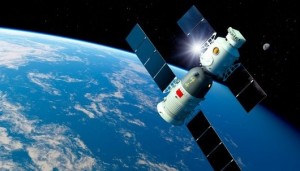
 Less than ten years ago, China sent the first man in space. Three years ago, it was announced that the first “taikonaut” (a professional space traveler from China) stepped into space. Tuesday, China informed that it will have its own space station, in less than ten years. Moreover, the first module of the new Chinese outpost in space will be launched next year and it will be named Tiangong, meaning “Celestial Palace”.
China also hopes to have the first moon landing in the next two years and have a taikonaut on the Moon by 2025.
For now, China’s space plans reveal ambition and energy unmatched by other space powers. Moreover, it threatens to change the present balance of the power in space. A NASA representative, quoted by the Guardian, describes this stage of China’s space plan as “a powerful political symbol”.
The initiative is taken at a symbolic moment: U.S. retires their last three spacecrafts, and an alternative program will be developed someware in the future, and it will be materialized much later.
Under these circumstances, only Russia will also have the necessary vehicles to rotate the astronauts on the International Space Station that would have to be retired in 2020, however, the project worth 100 billion dollars might be extended until 2028.
The new Chinese space station will be smaller than the International Space Station. The Chinese station will weigh about 60 tons and will have a central module and two laboratories for experiments. The new station does not have a name yet, so the Chinese public has been asked to suggest names and symbols. Until then, the whole project is known under the name of their first module, Tiangong.
Jiang Guohua professor at the Chinese Center for Research and Astronauts Training, explained that the new construction will have a life span of a decade, and it will be able to support three astronauts on board who will focus on the study of microgravity, solar radiation biology, and astronomy.
The central module of the Chinese space station will be 18.1 meters in length, with a diameter of maximum 4.2 meters and a weight of 20-22 tons. The modules that will host laboratories will be shorter, only 14.4 meters, but will have the same weight and same diameter.
Pang Zhihao, a researcher and chief editor of the International Space magazine said that “the 60-ton space station is rather small in comparison with the International Space Station – 419 tons, and Russian station Mir – 137 tons, which was used from 1996 to 2001. But it is the third multi-modular space station in the world, which generally requires technology far more complicated than a single module with laboratory space”.
China also builds a transport spacecraft for the Tiangong project, which will weigh less than 13 tons and will have a diameter of 3.35 meters, to be used for the transport of supplies and equipment to the space station.
NASA is not alone heeding China’s space ambitions. The European Space Agency (ESA) also looks forward to the east. Bernardo Patti, ESA’s space station program chief, said that “China is a big country. It is a strong country that becomes richer and richer. They want to assert themselves as important players in the international arena. They decided to become politically autonomous and they are working on it … Another country trying to build their own infrastructure in space means competition, and competition always pushes you to be better”.
Patti says that China’s plans will “make think” a good number of politicians from everywhere.
ESA and other nations are already talking about a new space station to operate as base of launching missions of space exploration beyond Earth orbit. According to these plans, future missions would require returning astronauts on the moon, landing them on asteroids, or even venturing beyond Mars.