
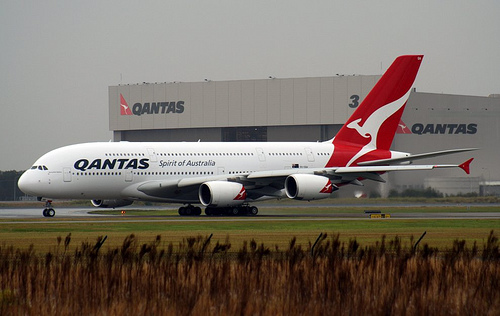
Qantas Airways plans to resume a few Airbus A380 flights this week, giving a breather to Rolls-Royce after an emergency landing earlier this month due to the mid-flight failure of one of its engines.
This decision comes after some tough checks on Rolls Trent 900 engines, which was supervised by Qantas, EADS unit of Airbus and Rolls-Royce. Investigators concluded that the plane is safe to fly.
Nomura Aerospace analyst Jason Adams said that it was very good news and that the companies were confident enough about the safety of the plane to allow the flights to resume. He said that a lot of work was done to ensure the safety and now they must be confident enough that there is little risk involved.
A green signal was also given by Europe’s aviation safety authority (EASA) after conducting some tests on the engine after one was damaged in mid-flight, forcing Qantas to ground its six A380’s
Rolls Royce’s shares have declined 10 percent after hitting an all time high in November, three days before the incident.
Shares in Rolls were up by 2 percent at 602.5 at 1225GMT, and EADS had slipped 1 percent to 16.81 euros.
The shares in Qantas closed up 0.4 percent at 2.64 dollars on Tuesday, after falling 7.6 percent after the blowout incident.
Qantas’ move will come as a boost for Rolls Royce who have been muted to the crisis so far.
A Rolls Royce spokesman said on Tuesday that they were delighted that Qantas was resuming its flights, saying they were working closely with Airbus and other airline companies to ensure safety.
The decision also comes at a key time for Airbus, whose delayed 16 billion dollar A380 program has yet to attract worthwhile airlines in the major markets such as the US and Japan.
An airbus spokesman said that they were working closely with their costumers and were delighted by Qantas’ decision.
Two of the six A380’s in Qantas’ fleet will resume operations while others will take some time owing to the engine fixes.
Qantas CEO Alan Joyce told reporters in Sydney that they have chosen 16 engines that had more risk of getting a problem, and those engines would be modified. He said the issue was a worldwide one, not just for Qantas, because other airlines also use the engines and the problem has to be solved for all the operators.
Qantas will not, however, fly any of the A380 until the Civil Aviation Safety Authority has cleared it. John McCormick, CASA’s director of aviation safety, said that the airline had agreed not to fly any of its planes until they are cleared. He said everything was being done so that the event won’t occur again.
The conclusion provided by Rolls-Royce said that the incident was caused by oil fire. But it is struggling to fix the problem and replace the engines with new turbines.
The conclusion of Rolls-Royce impelled to order a time consuming inspection which would take the planes out of service every 10 days or so, costing much money.
But due to the progress in the analysis, EASA said the new plan would not be needed.
Qantas said that it would not use the A380 on the high margin route of Sydney-Los Angeles, because a maximum thrust of 72,000 pounds was needed there.
The A380 would be reassigned the Sydney-London route on Saturday.
The Sydney-Los Angeles route is the longest served by an A380 plane, and require the plane to be full on fuel, which requires more thrust to take off.
Rolls Royce did not comment on whether it had told the operators of Trent900 not to use the engine above 70,000 pounds of thrust.
Analysts say the disruption of the A380 would impact Qantas monetarily, it will be less but noticeable. But Qantas refused to comment. According to a note by Macquarie, the disruptions and 1 percent decline on mainline international capacity for first half of 2011 would cost Qantas around A$20 million.
Joyce said that Qantas will discuss compensation with Rolls when time is right.
