
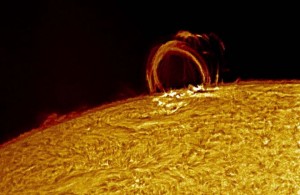
 An atypical solar flare, located by the NASA space observatory, could disrupt Wednesday the activity of satellites, communications systems and power grids on earth.
U.S. National Weather Service NWS warned that, since 2006, there wasn’t any solar flare observed with such magnitude.
“On June 7, there was a solar flare of medium force (M-2) with a coronal mass ejection visually spectacular”, announced the solar dynamic observatory of the American Space Agency.
“The cloud of particles rapidly rose and then returned to the surface, appearing to cover an area almost half the solar surface”, the observatory added.
As the eruption was not directly pointing to the Earth, its effects should remain “relatively weak”, according to NASA.
The Space Center of the NWS forecast described the eruption as “spectacular” and “likely to cause a minor to moderate geomagnetic storm, on 8 June, starting at 18:00 GMT.
The storm “contains a large quantity of high-energy protons (over 100 MeV), a situation which has not occurred since December 2006, NASA added.
Geomagnetic storm could cause disruptions in electric power grid and operation of satellites, particularly GPS, and could lead to modification of routes of passenger aircraft over the polar regions.