
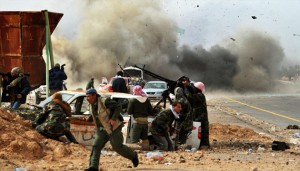
France has exerted pressure on its partners in the G8, meeting Monday in Paris for two days at the level of heads of diplomacy, in order to quickly get UN approval for military action in Libya, where Muammar Gadhafi’s forces move forward, informs AFP.
Ministers of this group of most industrialized countries: USA, Russia, Japan, France, Britain, Germany, Canada and Italy would also discuss on Monday evening during a dinner party and work session Tuesday about the consequences of the earthquake and tsunami in Japan.
For France, which campaigns – along with Britain – to protect Libyan civilians, a resolution authorizing use of force in Libya this week is still possible, intervention should take place sooner rather than later, according to the statement made in New York by the French Ambassador Gerard Araud.
Russia opposes the military option, saying that there remain “fundamental problems” to solve. Germany also claims that a number of issues “remain unanswered”, preferring the political and economic pressure against Gadhafi.
G8 foreign ministers on Monday evening were greeted by French President Nicolas Sarkozy, who spoke an hour with the Secretary of State, Hillary Clinton.
At UN, France tries to promote a draft resolution, “the widest possible” in its wording about the air force without recourse to focus on an air exclusion zone. It is possible to obtain “surgical strikes this week over airports and Gadhafi’s transmission system”, a French government official stated on condition of anonymity.
While Colonel Gadhafi troops continue their victorious offensive, any international military response might take place too late. According to experts, specific raids or an air interdiction zone can slow down the advancing of ground troops, but they are not able to block them.
The situation in Japan, the damage from Cote d’Ivoire and the rebellion movements in the Arab world will also be addressed by the G8 heads of diplomacy.
“Takeaki Matsumoto, the Japanese Minister to the G8, could help to better define how to move swiftly, but also medium and long term to help Japan overcome the consequences of the earthquake and tsunami that hit on Friday” according to the French Ministry of Foreign Affairs.