
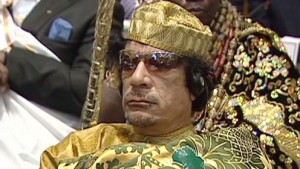
 Libyans are armed to the teeth. So far, the country resounds of people celebrate their victory, as usual, pulling shots into the air. The dictator began to rot in Misrata. And a dead Muslim has four rights on the living living: to be washed, to be embalmed, to be uttered prayers and be buried. National Transition Council would like to do all this in secret, not to make his grave a pilgrimage place or let it found by profanators. Safiya, the wife of King of Kings of Africa, from her exile in Algeria, addressed international organizations, claiming the body, “in the name of the combatant martyr Muammar Gaddafi’s family”. (It’s unlikely to get it).
What’s left in the family? Daughter, Aysha, is also in Algeria, together with two brothers – Muhammad (firstborn son from Colonel’s first marriage) and Hannibal. Sayf al-Arab was killed in a bombardment of NATO, at the end of April. Khamis (youngest) died in late August, near Tripoli. Mutassim has smoked last cigarette on Thursday in Sirte. Saadi fled to Nigeria apparently after trying to negotiate with the rebels a truce at Bani Walid (strange approach is understandable, but the young son was a football player). Sayf al-Islam, captured in Sirte, is now in teh Council’s custody. They say he’s badly injured.
African Union is silent. Working almost naturally, if we think about its losing the generous sponsorship of Libya. Silent musing. Again naturally – fears that the transition could turn Libya into the Afghanistan of Africa.
What will happen next? In an optimistic scenario, there will be elections in June 2012 as promised by the National Council of Transition. Until then there should be invented some political parties (Gadhafi was of the view that the parties are merely “abortions of democracy”, so no more fumbling with them). With only 5 million people (Out of 6 million people, one million is foreign workers, although their number is significantly higher), the sweet oil and gas and other equivalent “$10 billion in gold reserves” at the Bank (According to the governor, Farhat Bengdara, that was to join the rebels just in time), Libya could be one of the most prosperous countries in the world. It is true that infrastructure reconstruction after bombing will last about ten years (according to estimates on the spot), but that’s not bad: it will keep busy those who, with a gun in hand and Berber blood boiling might come up with ideas of retaliation or revenge.
The realistic version is that, first, the country’s interim leadership will have to persuade people to lay down their guns. The ones taken from the dictator’s deposits (a huge amount), those dropped by the French (many already snatched and carried by mercenaries to Mali or Nigeria, or carried by Tuaregs on the smuggling roads), the one million guns given out by the dictator himself, in March, to civilians (“men and women”). But the Council and paramilitary factions that have contributed to Gadhafi’s demise were not able to agree even on the time and place they will announce the cessation of hostilities. Eventually, they decided on this day in Benghazi (where the riots started in February).
You might have heard since March onwards of beautiful names: Ras Lanuf, Az Zawiya, Tobruk, Sarir, El Brega. You’ll hear about them again. They are refinery locations, which the bombings have avoided with perfect precision.