
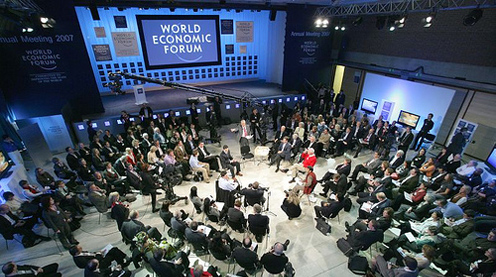
 The most powerful politicians, bankers and business people meet to fix the world that some of them took on the brink of collapse. Five years after the outbreak of the global financial crisis, the Western economies face the image of a lost decade, and experts say that global economic problems could be worse if Europe will not find solutions to end the sovereign debt crisis. This is the atmosphere that will be sensed at the Davos World Economic Forum, an annual meeting attended by the most powerful names in politics, finance and business.
The agenda of politicians and officials of international institutions is very busy before the meeting in Davos, which will take place in Switzerland from January 25 to 29. IMF chief Christine Lagarde was in Berlin yesterday to try to persuade the Germans to participate in the increase by 500 billion dollars of funds that institution can lend to troubled countries. G20 officials asked Europe to double the capacity of emergency fund to $1,000 billion and euro zone finance ministers meet today to set up tax details of the pact.
The world at crossroads
Leaders of 40 countries will go to Davos to discuss the reforms to repair the capitalist system, badly damaged by the crises of recent years. “We have a moral problem, we are indebted, we have neglected investment in the future, we underestimated the social cohesion and are in danger of losing all confidence of future generations”, describes Klaus Schwab, host and founder of the World Economic Forum, the state of the world today. “Solving problems in the context of obsolete and about to collapse models will only throw us deeper into the hole. We are in a time of profound changes that require new ways of thinking”, continued Schwab. “Capitalism in its current form has no place in today’s world”.
About 2,600 political and economic leaders, including 40 heads of state and government will have to come up with ideas to redesign the world at the meeting in the Swiss ski resort that has the theme “The Great Transformation: shaping new models”. Discussions will focus on ideas such as: economic growth, job creation, leadership and innovation or technology. Opening speech of the meeting will be held by German Chancellor Angela Merkel and will be followed by a debate on the role of capitalism in society. Most likely, the inability of European leaders to end the crisis and its effects on global economic problems of Europe will be the main topics of debate in the Forum.
“The main topic of discussion will be state of the global economy. There will be little discussion about social and environmental responsibility, these issues only come forward when the economy goes well”, says John Quelch, dean of the China European International Business School.
The presence at the Forum is expensive
Access to the Forum is by invitation only, this year 2,600 people will participate representing 100 countries. Among them are executives or representatives of the largest companies in the world, politicians and heads of state of the G20 countries, technology innovators and philanthropists. But invitations are free only for a few of the participants. A non-VIP invitation to the forum costs at least $71,000, while for access to private meetings, the cost starts at $156,000.
The strategic partners of the event, such as Goldman Sachs and Bank of America, paid $527,000 for membership and $19,000 for each invitation, up to five. Among them we find ArcelorMittal, ABB, Bill & Melinda Gates Foundation, Coca-Cola, Deutsche Bank, GDF Suez, Google, Intel, JPMorgan, Lukoil, Microsoft, Metro, Nike, PepsiCo, Renault-Nissan, Sberbank, Thomson Reuters and Volkswagen .
