
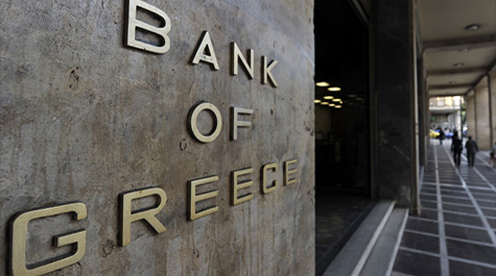
 Recapitalization of the four largest banks in Greece with 18 billion euros could help stop the money bleeding that took place in the last two years and a half, during which customers withdrew 75 billion euros from Greek bank deposits, according to a Bloomberg analysis. Greek Financial Stability Fund approved Tuesday night recapitalization of National Bank of Greece, EFG Eurobank Ergasias, Alpha Bank and Piraeus Bank with 18 billion euros and sent Wednesday the related contracts to the four institutions and the European Financial Stability Fund for approval and signing.
Withdrawals from the Greek banks rose sharply after the elections of May 6, which did not give a ruling coalition. Parties who oppose austerity measures stated in the external financing agreement with the EU, IMF and the ECB have made significant gains in May elections, and the two big parties that have dominated Greek politics in the last four decades have failed to win a majority. The worrying result of elections increased the likelihood that Greece will leave the euro area and default on its debt, since failure to comply with the agreement of external financing would lead to blocking international aid.
Last week, European Central Bank stopped access of several Greek banks to refinancing operations, saying that the banks have too little capital reserves to be considered solvent. Thus, Greek banks financing depends on emergency liquidity provided by Bank of Greece. “The election result has shocked and was marked by the growth of anti-bailout political parties. Such prospects create anxiety among those who have deposits. There have been massive withdrawals of deposits immediately after May 6, which have continued for several days. Recapitalization will help overthrow deposit outflows,” commented for Bloomberg Michael Massourakis, chief economist at Alpha Bank in Athens.
Withdrawals have slowed down early last week when the governor of the Central Bank of Greece, George Provopoulos, told Greek President Karolos Papoulias that people and companies took out 700 million from deposits in one day, according to banking sources. They have said that May withdrawals will not exceed the “peaks” of the previous months. Greek newspaper Proto Thema wrote last week that the central bank is preparing to impose capital controls, an announcement that triggered Monday again an accelerated withdrawal from bank deposits, according to a source.
Bank deposits in Greece in February decreased by 4.6 billion euros, approximately 2.8%, amid negotiations of the Greek government for restructuring part of the debt. In March, deposits increased by 1.4 billion euros, according to central bank data, a trend that continued in April, says Massourakis. Bank of Greece will present information on deposit developments for April in late May.
“When there has been an increase in fear of leaving the euro area, the withdrawals have temporarily increased. Losses of deposits were caused by the fact that the population started to spend from savings due to the reduced discretionary income,” says Paul Mylonas , director of strategy at the National Bank of Greece, the largest Greek bank.
Andreas Koutras, an analyst at ITC London Markets believes that Greek banks have suffered, in 2009, a “marathon” of withdrawals from deposits. “As long as there is support for them at the ECB, they can survive for a long time,” he said.
The four major Greek banks have recorded total losses of nearly 28 billion euros from the debt restructuring of Greece, accounted in the last year. Losses have exhausted almost all institutions’ capital reserves. Capital injection of 18 billion euros will enable them to access the new ECB refinancing operations.
The recapitalization will be done through an issue, by the European Financial Stability Fund, of securities totaling 18 billion euros, guaranteed by euro area governments. Titles can be used by Greek banks as collateral for ECB operations. “We are used to instability and recent outflows of deposits do not threaten liquidity. Banks have been recycling funds from the ECB since international financial crisis of 2007-2009. We’ve been repeatedly confronted with impaired liquidity,” concludes the chief economist from Alpha Bank.

Reply