
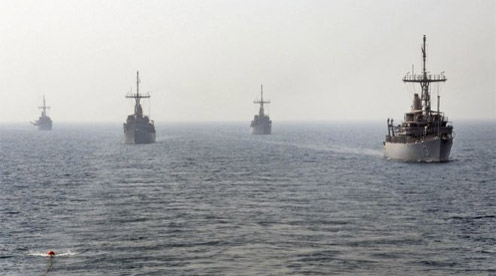
 Mine-clearing operations under the command of U.S. Navy began Sunday in the Persian Gulf amid international tensions because of Iran’s controversial nuclear program. Twenty countries will participate from September 16 to 27 in this international exercise, reads in a statement of the regional headquarters of U.S. naval forces in Manama (Bahrain).
Sunday, Iranian Revolutionary Guard leader, General Mohammad Ali Jafari, threatened to target the Strait of Hormuz, where an important part of global oil transportation passes, in case of a military attack against his country. Israeli Prime Minister Benjamin Netanyahu called on the same day, Washington and the world to set a “red line” that should not be passed by Tehran, saying that Iran will in 6-7 months on brink of being able to make a nuclear bomb.
U.S. naval headquarters underlined “global defense” character of the exercise. The international fleet will take part in a “defense exercise designed to ensure freedom of navigation in international waters in the Middle East and to promote regional stability,” said the statement.
According to the scenario for the naval exercise, the engaged ships “will respond to a simulated attack as a mining of international waters, to enforce freedom of navigation on the sea routes”. U.S. military officials ensure that these operations are not targeting Iran in particular. “Theme of the exercise is mining and the contribution to an international effort to set free the routes” insisted the chief of U.S. naval forces in the Gulf, Vice Admiral John Miller.
However, the New York Times on September 10 said that the administration of President Barack Obama wanted to increase the pressure on Iran to negotiate seriously and to avoid the dangers of a possible Israeli pre-emptive operation against Iranian nuclear facilities. The newspaper considered the de-mining exercise one of the means of pressure.
Israeli leaders have threatened several times with striking Iranian nuclear sites in the event that sanctions and diplomatic efforts of the international community will fail to persuade Tehran to halt its research on nuclear weapons.
Raising the bar, General Jafari warned Sunday at an ad-hoc press conference in Tehran that “there will be nothing left of Israel, given its small size and our missile capabilities,” if the it would dare to attack Iran.
However, Iranian Revolutionary Guard leader reiterated that “the United States are vulnerable around Iran and their bases (in the Middle East) are within range of our missiles.” For this reason, an attack against Iran is unlikely. Israel “will not succeed in convincing the United States to join an attack against Iran” and Israel “will not attack without American approval,” he assured.

Reply