
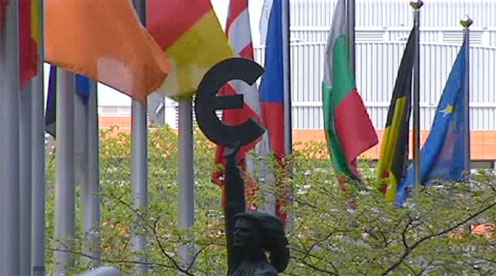
 Eurozone launched Monday in Luxembourg its main instrument to fight the crisis, the so-called “European Stability Mechanism”, expected to provide €500 billion to help countries in trouble. Spain could be the first country that will appeal to those resources.
“The launch of ESM is a historic step in the construction of monetary union. The euro area is thus provided with a permanent and effective shield,” said Eurogroup chief Jean-Claude Juncker.
ESM will replace the current European Financial Stability Fund. It will become fully operational when the states will shed contributions, and will reach a capacity of loan of €200 billion by the end of this month, from a total of €500 billion.
Fitch Ratings gave ESM the triple A rating, which allows it to get financing at attractive interest rates.
European Stability Mechanism is of strategic importance because it will be able to directly recapitalize banks in the euro area, without increasing indebtedness of states. The condition is that European countries will create a common mechanism of banking supervision, until early 2013.
The possibility of direct recapitalization of banks is of interest primarily to Spain, who obtained in June a credit line of up to €100 billion from the euro area to support its financial institutions. Meanwhile, Greece is looking desperately for a vital tranche of the loan from the EU and IMF. And it mobilized 7,000 police in Athens for Tuesday’s visit of Chancellor Angela Merkel. Hundreds of pensioners burdened by austerity and fearful of new budgeting plans were pushed back by riot police. They burned the EU flag in front of Brussels representative in the Greek capital.
It was just the warming up for other demonstrations, announced on Tuesday, when in Athens is expected, for the first time since the beginning of the crisis, Angela Merkel. She comes with a “respect and recognition” message of efforts made by the Greek people. But in the eyes of the common people she is the main responsible of draconian austerity cure and more closely she embodies the international tutelage to which Greece is subjected.
Through the vision of a British director, the complicated relationship between lazy Greeks burdened by the crisis, and the Germans less willing to pay resembles a marriage with fighting between spouses which are called, symbolically, Greco and Germaine.
But it is much more dramatic in real life. Greece has not yet received the next tranche of aid, vital, without which it can not avoid bankruptcy. And the eurozone finance ministers, gathered in Luxembourg to launch the European Stability Mechanism, will not take any major decision yet.
“All we can expect is some positive comments, respect for the efforts that Greece made. The most important consequence of the fact that we have not yet adopted the new austerity package means postponing the tranche of €31 billion, probably to mid or late November,” said Theodore Krintas, financial market analyst.

Reply