
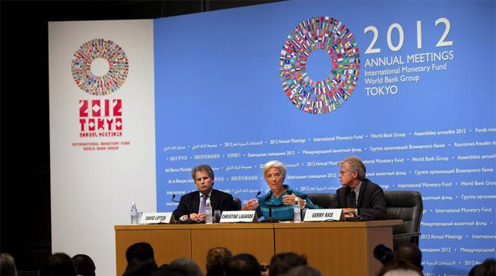
 Finance ministers and central bank governors from around the world, gathered in Tokyo for the annual meeting of the International Monetary Fund, adopted Saturday a list of policies to address the debt crisis in Europe and the United States and promised to review the progress made in six months in the context of attempts to spur economic recovery, according to Reuters.
The global policy agenda, which includes 10 pages, largely summarizes some previously planned measures such as the establishment of an European Central Bank program of bond purchases and solving the so-called “fiscal cliff” in U.S. that requires automatic spending cuts and tax increases that would come into force early next year if Congress does not act.
The list of measures and verification provided after six months are designed to empower countries to meet their commitments, a recognition of discontent from the IMF, but also from many emerging market economies towards the fragmented response to the crisis.
IMF chief Christine Lagarde said that member countries managed to limit their differences in applying the strategy, seeking to mitigate misunderstandings between the Fund and Germany over the terms by which countries with large debts such as Greece must return to a balanced budget.
“There was no objection to the recommendation that we have given to the member states, namely ACT,” said Lagarde. “Maybe we haven’t agreed on all issues, but I believe there is a general consensus that collective action will bring results,” she added.
Officials said, however, that IMF assured European leaders that it is not willing to give money to Athens without strong moves which lead to lowering the debt levels. But as the Wall Street Journal commented, spending cuts in the eurozone is a real anathema because of political repercussions.
In a release issued after two days of discussions, members of the IMF warned that global growth is slowing and there are still uncertainties and risks to drop. However, representatives of 188 countries have welcomed the measures already adopted, especially in Europe. They appreciated that the measures taken made the world financial system safer, even though they have not yet gone far enough.

Reply