
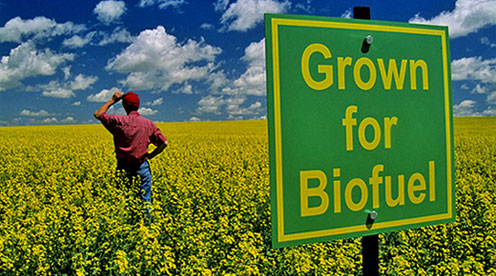
 Before the era of fossil fuels, the food was the source of energy for both humans and animals, and the latter was, together with the wind, the main way of transportation. Food availability was limiting the number of people who could be fed and the Malthusian nightmare of reaching sustainability limit was never too far away. Fossil fuels have cut the umbilical cord between energy and food, and the population exploded. Now, through biofuel, food will become again a source of energy.
According to the Global Renewable Fuels Alliance organization, the biofuel generated business worth $374 billion in 2010. Between 2000 and 2010, world production of biodiesel increased 22 times, and the production of bioethanol has tripled.
The organization estimates that by 2020 bioethanol will record an advance of 74% to $525 billion and the biodiesel business will double to $154 billion. The market will reach $680 billion in 2020.
An increase like that of biofuels would not have been possible without the help of the governments. “If biofuels would have been competitive without government subsidies related to fossil fuels, the interaction of market forces have would led to an optimal distribution of agricultural commodities between food and energy,” says Ivette Gerasimchuk specialist at the International Institute for Sustainable Development in Geneva. “The market is currently heavily influenced by tax exemptions and other type of Government support for biofuels industry,” said Gerasimchuk.
The United States is the largest consumer of bioethanol in the world and the European Union’s is the leader of biodiesel production. About 10% of the gasoline in the United States is assured of ethanol, and the percentage would increase, supported by a 2007 law to ensure the energy independence. Around 40% of the U.S. corn crop this year will be converted into biofuel to comply with regulations imposed by the state. This amount would be sufficient to feed about 350 million people.
Many countries, including the U.S., China, Brazil, India and EU Member States have adopted policies to promote biofuels and reduce their dependence on imported oil. In general, the work focused on the impact of shifting from food crops to biofuel production suggests that a price increase of 30% or even higher in the short term.
Even in the case of a modest impact of energy policies on food prices, the effect on the population may be major, pushing tens or even hundreds of millions of people below the poverty line.
A mix between oil price rise, the growth of biofuel production, speculation on commodity markets and export restrictions by some countries caused food prices to rise sharply in 2007 and 2008, triggering violent protests in countries like Egypt, Cameroon and Haiti.
Food prices have risen worldwide in September and the UN Food and Agriculture Agency warned that they remain close to the level reached during the crisis of 2008.
The strongest drought in more than 50 years in the U.S. has sent prices of soybeans and corn to record levels this summer. Severe drought in Russia and other countries of the Black Sea region has sparked fears of a new food crisis. According to the UN agency, prices will remain high, and normalization is unlikely in the short term.

Reply