
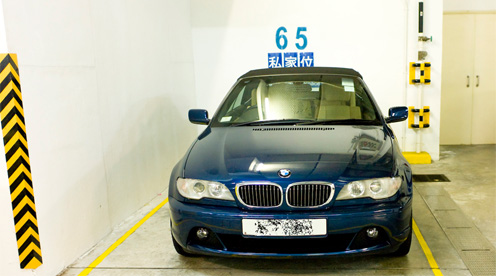
 The most expensive parking spot in the world is held and have been used in the last decade by the executive of a real estate company, called by the press as “the parking magnate.” He speaks with excitement about the property which he is in no hurry to sell.
Tucked away in the jungle of skyscrapers in Hong Kong, the most expensive real estate market in the world, a property of $640,000 awaits a buyer looking for a bargain.
For Hong Kong, the sum seems ridiculously low, especially in a market where real estate market prices have doubled in the past two years, says CNN Money. The property in question is not a dwelling or office, but a parking space.
At $5,000 per square meter, it is the most expensive parking spot in the world, owned and used for the last 10 years by Jacinto Tong, CEO of real estate company Gale Well Group. Tong speaks with exuberance about his “priceless” property.
“I think this is the best parking spot that I ever had. You can go directly to the office, by elevator. It only takes 20 steps. 20 Steps,” the executive said.
Gale Well Group has hundreds of residential and commercial spaces in Hong Kong and Tong has two parking spaces, for which he boasts that he could get $1.3 million. “Here we do not mind paying more. But I’m in no hurry to sell,” he says.
According to the latest survey conducted over parking prices by Colliers International, Hong Kong has the most expensive rent in the Asia-Pacific region.
The average price of a parking space in Hong Kong last year was $744.72 per month, followed by Tokyo at a dollar less. The main reason for the huge price of the property market in Hong Kong is tough regulations imposed by the government in this sector.
Many analysts believe that Hong Kong residential property market is a bubble about to burst. To deflate it slowly, without risks, the government introduced since November 2010 a series of strict regulations that hinder rapid purchases and sales for speculation.
Regulations have resulted in the number of housing transactions dropping by 31% in the last 23 months. The side effect is, however, investors transition to commercial premises, including parking lots, which are not yet strictly controlled by the government.
The number of parking space transactions increased by 25% in the same period, while industrial and commercial property volume rose by 16%.
In the first 11 months of this year, the amount of parking space transactions in Hong Kong was $751 million compared to $525 million throughout 2010.

Reply