
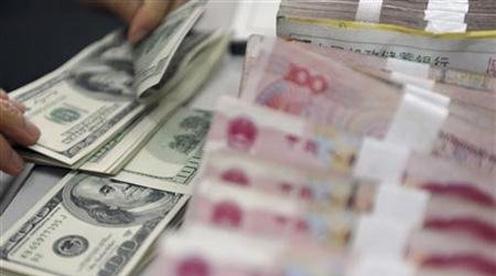
 The United States has avoided the word that makes Beijing angry, but nobody is naive. By declining to qualify the world’s second largest economy, China, as an exchange rate manipulator, the U.S. Treasury made an exercise in diplomacy. However, currency manipulation, most often to make exports cheaper, has become a normal and outright practice which, apart from verbal protests from trading partners, is without too much risk. Such practices cost $1,500 billion a year, estimates Joseph E. Gagnon, a former Fed economist and U.S. Treasury, writes Les Echos.
The eurozone and the U.S. are the main victims of the 20 states known to manipulating exchange rates. Of these, half are in Asia (among them China, Japan, Thailand, South Korea, Hong Kong and Singapore), four in Africa and the Persian Gulf (Algeria, Saudi Arabia, Angola and Libya) and three in Europe (Denmark, Switzerland and Russia).
“Since 2001, exchange rate manipulation aimed at increasing current account surplus with an undervalued currency. It is a difference compared to previous decades when currency manipulation targeted strengthening and overvaluation of currency, while the devaluation was seen as unpopular and a potentially inflationary policy,”
says Gagnon.
In order to influence the exchange rate of their currencies, governments have several tools at hand, like central bank intervention in the forex market, taxes and exchange control. By artificially lowering the value of money, developing states could increase by $700 billion their current accounts in 2011. Also, the by manipulation their currency, developed countries have caused trading partners losses of nearly $500 billion per year. The total cost of $1,500 billion doesn’t take into account the sovereign funds.
“One of their objectives is to invest outside their country, leading to devaluation of the local currency. This is indirect manipulation,” says American economist. The list of culprits includes many countries which have sovereign funds, such as China, Saudi Arabia, Russia and Singapore.
The countries in Middle East and Africa are those that have the largest reserves in relation to their GDP. Asian countries, which growth depends heavily on exports, made from their current account surplus a national priority. In its statute, the International Monetary Fund urges countries not to influence exchange rates. But, since the adoption of these rules, in 1978, the institution has never published the names of those who violate this principle. And there is no sanctioning procedure against them.

Reply