
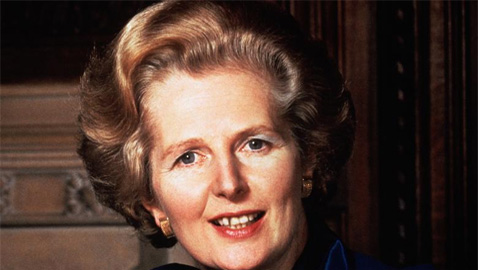
 Former British Prime Minister Margaret Thatcher died Monday at the age of 87 following a stroke, said her family spokesman, Lord Bell, quoted by the international press. “It is with great sadness that Mark and Carol Thatcher announced that their mother Baroness Thatcher died peacefully following a stroke this morning,” said Lord Bell.
Margaret Thatcher, dubbed the “Iron Lady”, was prime minister from 1979 to 1990, the first woman who held the highest political position in Great Britain. Baroness Thatcher, born Margaret Roberts, became Conservative MP for Finchley (London) Constituency in 1959. Aged 66, she retired from the House of Commons in 1992.
She served as Minister of Education and ran against Prime Minister Edward Heath for the position of leader of the Conservative Party in 1975. She won the general elections in 1979, 1983 and 1987.
Former Conservative prime minister Margaret Thatcher, who died Monday at the age of 87 years, will remain forever the “Iron Lady” who reshaped Britain with an intransigent economic liberalism and restored the country’s international prestige, according to AFP.
Her strong gaze symbolizes a remarkable strength of character. “I am not a consensus politician,” she often said. “I am a conviction politician.” This refusal to compromise had its origin in deeply rooted principles: social conservatism, economic liberalism and the idea of her country greatness.
These beliefs come from the strict education received from her Methodist father. Margaret Hilda Roberts was born October 13, 1925, at Grantham (central England). She became a lawyer after marriage, in 1951, and joined the Conservatives. In 1959 she was elected Member of Parliament (MP). Between 1970 and 1974 she was Minister of Education.
In 1975, Thatcher takes over the Conservative Party leadership after defeating Edward Heath and four years later the Conservatives win the general election. Her political legacy includes the recovery of a sick British economy: she excessively privatized, lowered taxes and public spending and reduced to silence the unions. As the three million unemployed threshold has been exceeded in early 80s, miners’ strikes were struck by her intransigence.
She tried to restore the prestige of the former British Empire. The recapture of Falkland Islands (Malvinas) in 1982 from Argentina has contributed to this. Very close to Ronald Reagan and Mikhail Gorbachev, she also contributed to the end of Cold War.
But her relentless nature turned against her. Rejection of a local tax that she failed to impose, brought her rule to an end. Challenged within her own party, she tearfully resigned in November 1990.
Thatcher retired in London’s Belgravia to write her memoirs and finally left the political scene in 2002 for health reasons.
In June 2003, the death of her husband, Denis, deeply affected her. Mark Thatcher, her son, had legal problems after he was involved in a coup d’etat in Equatorial Guinea. He was fined $500,000 and received a four-year suspended jail sentence.
In December 2005, two months after her 80th anniversary at a London hotel, in the presence of Queen Elizabeth II, she is hospitalized. Her daughter, Carol Thatcher, revealed in 2008 that her mother was suffering from senile dementia, often forgetting that her husband was dead.
Since then she has lived an isolated life, without attending receptions at Downing Street by Prime Minister David Cameron to celebrate her 85-year anniversary in 2010 and the Queen Elizabeth II celebration in 2012.
Hospitalized during the holiday season of 2012, she underwent surgery for bladder nodules and was since then recovering.

Reply