
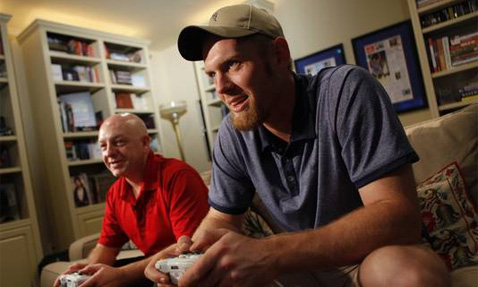
 A study by researchers at the University of Iowa in the United States revealed that video games can be beneficial by delaying the aging process.
Video games, sometimes considered harmful to children, are instead beneficial for people aged over 50, mobilizing and enhancing their cognitive abilities, said the authors of a U.S. study published this week.
The few hundred people aged over 50 who were monitored by researchers at the University of Iowa in the United States have shown signs of improvement in their cognitive capacities and a delay of several years of mental decline associated with aging.
It is the last of a broad range of studies aimed to understand the reasons why, when they get older, people lose the major functions of the brain that help with memory, attention, perception and the ability to solve problems.
In this study, 681 people who were in a good health, were divided into four target groups, within which the were separated into two subgroups: one for people between 50 and 64 years of age and one for people over 65.
One group had to solve crosswords on the computer, the people in the other three groups had to play a video game called “Road Tour”, which consists in identifying a vehicle model shown briefly and then re-identifying the vehicle type and match it with a road sign. The aim is to increase the level of difficulty. At each level the speed increases, so does the number of distracting elements on the screen.
“The game starts off with an assessment to determine your current speed of processing. Whatever it is, the training can help you get about 70 per cent faster,” said Fredric Wolinsky, professor of public health at the University of Iowa, lead author of the study published in the journal PLOS One.
Elderly people that played at least 10 hours of the video game delayed the cognitive skills decline by seven years. The group that played the game for at least four hours gained four years of cognitive improvement a year after the study started.
“We not only prevented the decline; we actually sped them up,” says Professor Wolinsky. “We know that we can stop this decline and actually restore cognitive processing speed to people. So, if we know that, shouldn’t we be helping people? It’s fairly easy, and older folks can go get the training game and play it,” added the lead author of the study.
People who have played “Road Tour” have achieved better results than those that solved crosswords regarding concentration, speed and agility to move from one task to another. In total, the games can translate into an improvement of 1.5 years up to 7 years for these mental functions.

Reply