
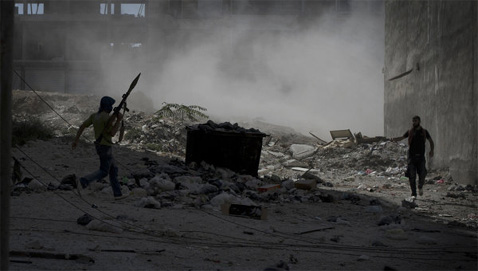
 There is “strong, concrete suspicions but not yet incontrovertible proof” that Syrian rebels have used sarin gas, said Carla del Ponte, a member of the UN Commission of Inquiry on human rights violations in Syria, in an interview with a Swiss-Italian radio station on the night of Sunday to Monday.
“Our investigators have been in neighbouring countries interviewing victims, doctors and field hospitals and, according to their report of last week which I have seen, there are strong, concrete suspicions but not yet incontrovertible proof of the use of sarin gas, from the way the victims were treated. This was use on the part of the opposition, the rebels, not by the government authorities,” added del Ponte, former prosecutor of the International Criminal Tribunal for the former Yugoslavia.
She explained that investigations of the UN Inquiry Commission, which is expected to submit their observations at the next session of the Human Rights Council in June, are far from over. She said that ongoing investigations could determine whether Bashar al-Assad’s government used chemical weapons or not.
Sarin is a powerful nerve gas, discovered before the end of World War II in Germany and used in the Tokyo subway in 1995. In addition to inhalation, just the skin contact with this gas blocks nerve transmission and cause death by cardiac arrest. The lethal dose is half of milligram per adult. The gas is odorless and invisible. Victims complain in the beginning of severe headache pain and have dilated pupils. Subsequently seizures occur, respiratory arrest and coma preceding death. The sarin gas can be used in the air, especially by the explosion of ammunition, but can also be used for water or food poisoning, according to the Center for Disease Control and Prevention (CDC) in Atlanta.
Both Syrian government and opposition rebels accused each other of using chemical weapons in attacks carried out in March this year and December last year.

Reply