
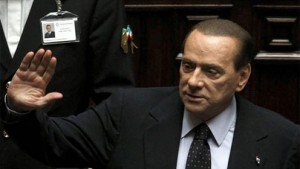
 Controversial Italian Prime Minister Silvio Berlusconi became on Saturday the latest victim of the politics of sovereign debt crisis in Europe. He resigned from the leadership of the Italian Government after the adoption by Parliament of the austerity measures required by the European Union. The news was received with applause in Rome, in a festive atmosphere reminiscent of the Italian national football team victories.
The 75-year-old media tycoon, who survived numerous sexual and financial scandals, was forced to leave the presidential palace through a secret exit after his resignation, while at the entry main demonstrators applauded and shouted “buffoon, buffoon!”. On arrival at the palace Berlusconi was greeted with chanting: “mafioso”, “shame”, “prison”, “it’s over!”, or “Primavera, primavera” (“Spring, Spring”), a reference to the Arab revolutions that removed from power totalitarian Arab regimes.
Berlusconi’s place will be taken by the former Cabinet Commissioner Mario Monti, aged 68. Prime Minister’s resignation comes as he promised, after Italian lawmakers finally adopted the reforms requested by the European Union to reduce debt and support the recovery of economic growth, according to AFP. In a tense atmosphere, the deputies adopted the draft with 380 votes “for”, 26 “against” and two abstentions. The main opposition party, Democratic Party, did not participate in voting deciding not to obstruct the adoption of such measures considered crucial.
“The curtain fell over a long and painful page in our history”, said Dario Franceschini, member of the Democratic Party. Italy is “a country that wants to turn the page over and start from scratch. We enter a new era: we will have to rebuild from ashes the economy, justice, election law”, he continued.
Difficult task for Berlusconi’s successor
Silvio Berlusconi’s successor has the difficult task of getting Italy out from crisis, forcing austerity measures on the Italians and adopt other reforms more urgent for economic recovery, writes AFP. “His mission will be to remedy a weak economy structurally to ensure that Italy survives on the financial markets and the euro area and to revitalize reforms, which are in a deadlock, as promised to the EU and IMF”, said Eoin Ryan, an analyst at IHS Global Insight.
One of the first work area for the new Prime Minister would be the reform of the pension system. He will certainly be working on budget issues, as required by the EU, which oversees Italy together with the IMF and the ECB. Another key reform is the labor market, a serious problem because all the unions threatened to strike against a project to facilitate layoffs.
The new head of government must be sure that he has a solid majority to adopt these reforms and, in order to achieve that, he has “to send the message that Italy will be subject to market will” and to convince at the same time that “people will accept severe austerity”, says Ryan. In addition to the debt problem, the new head of government will inherit the Italian economy and still maintains a sound footing. Italy does not have a real problem on a purely economic level, analysts appreciate. State budget deficit, estimated at 3.9% of GDP for this year is below the one of most European countries, households are less indebted, and the industry is diversified and exports a lot.