
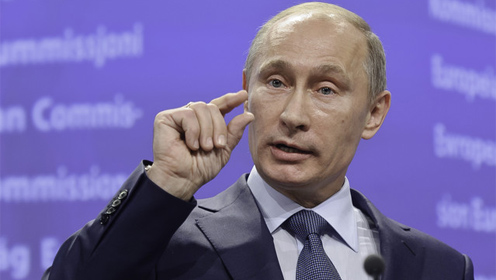
 Russian President Vladimir Putin faces a serious political instability if Greece will exit euro area, triggering a global crisis, lower oil prices and thus a recession in Russia, according to a study by the Center for Strategic Studies in Moscow. The probability of Greece exit from the euro area is over 50%, which could lead to withdrawal of other countries from the monetary union, said the institute’s director, Mikhail Dmitriev.
The main risk affecting Russia is the deteriorating of the economic situation, which would fuel anti-Putin sentiment and would increase political repression, reads the study of the institute, which advises the government, Bloomberg writes.
“If this trend continues, we will witness the escalation of political violence and repression, on the one hand, and a serious economic crisis on the other hand. This could lead to loss of control by Putin and a chaotic political transformation”, said Dmitriev.
Putin returned this month to the Kremlin for a third term, after tens of thousands of Russians demonstrated in major cities of Russia, following controversial parliamentary elections in December. Worsening global economic conditions could reduce the government’s ability to meet social commitments undertaken and could erase placements made by Russian investors in Europe, said Dmitriev.
“Despite economic recovery in Russia, there are large capital outflows from the country. This capital goes to the epicenter of the global financial crisis, which is Europe. It’s like creating a food vendor at the center of an atomic explosion,” according to the Russian analyst.
In the worst case scenario, after an exit from the euro area of Greece, Russia’s economy would contract by 2.1% and total equity withdrawn from the country would achieve in a year 95 billion dollars, said Wednesday Ksenia Iudaeva, Chief Economist at Sberbank, the largest bank in the country.
Russian economy would record a decline of 1% in 2013, and the country would reach a deficit of 5.5% of GDP, in the worst case considered by Vladimir Osakovski, chief economist at Bank of America Merrill Lynch in Moscow . Ruble would depreciate by 10% from its current level, consider Osakovski. Russia, which depends on oil and gas exports for half of government revenue, while Europe is the destination of over 50% of the country’s exports, could suffer a worse recession than in 2009, in the case of a collapse in energy prices, estimated Dmitriev .
Russia’s economy recorded an average annual growth of 7% during the Putin presidency from 2000 to 2008, prior to contract by nearly 8% in 2009 after oil prices plummeted from $147 per barrel to $34 per barrel following the financial crisis caused by the collapse of Lehman Brothers in August 2008. For this year, the Moscow government has reduced the growth forecast from 3.7% to 3.4%. In the first quarter, GDP rose by 4.9% compared to the similar period of 2011.
Quotation of Brent oil, which affects the price of Russian Urals oil could fall to $80 per barrel if the Greece will exit euro area or even to $60 a barrel if fragmentation of the monetary union would be messy. Ural Oil is currently traded at about $105 per barrel.
According to the Center for Strategic Studies in Moscow, population distrust in the government is at a critical level so that their inability to meet promises could lead to large demonstrations. “The political crisis can quickly become severe if aggravated by a new economic crisis. It is very likely to lead to rapid loss of political control and a rapid change of political system,” reads the study. Putin warned on Monday the new Medvedev government that it must face a difficult situation due to global economic uncertainties.

Reply