
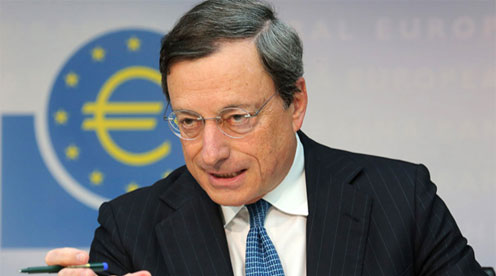
 European Central Bank (ECB) decided to start a new bond purchase program to drop borrowing costs for countries facing sovereign debt crisis, announced today Mario Draghi, President of the ECB. The decision announced by ECB is by far the most awaited moment of the last few months. Market turned optimistic after frantically waiting for this as the press called it the “Draghi day.” Euro went up to $1.26, its highest level in the last two months.
Trying to provide all the support needed to defend the euro, Draghi said that the new purchase of government securities, which will take place on the secondary market, will ensure the transmission of the effects of monetary policy decisions in all euro area member states .
According to Draghi, the decision will mitigate the turmoil on the state bond market and will alleviate the unsubstantiated fears of investors about the evolution of the euro. This scheme, which had a strong opponent in Bundesbank, will provide a “powerful countermeasure which will prevent destructive scenarios to materialize,” said Draghi. ECB maintained its key interest rate to 0.75% today.
Details of ECB intervention
ECB chief offered few details on unlimited bond buying plan. ECB will mostly buy government bonds with maturities of one to three years, including longer-term debt having residual maturity at this level, Draghi said. Purchases will be sterilized completely, which means that their impact on the monetary quantity will be neutral. During Draghi ‘s speech the yield for two-year bonds of Spain fell to 3.05%, after they grown strong before.
The ECB has been the main actor in the battle against eurozone crisis, which has so far put five countries in a position to need a bailout and brought eurozone economies sliding into recession.
Today the central bank revised down economic development forecast for this year from 0.1% to 0.4%. In 2013, the economy will grow, according to ECB estimate by 0.5%. In June, the bank forecast a growth of 1%. At the same time, the ECB increased the inflation forecast for next year from 1.6% to 1.9%.

Reply