
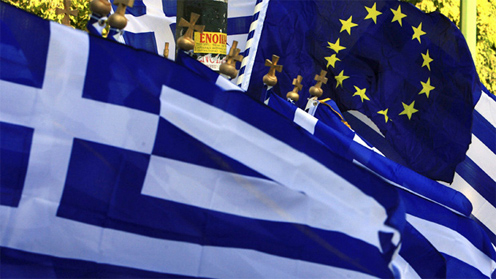
 From the European Central Bank’s monetary stronghold to the pro-European Grand Duchy of Luxembourg, European leaders are beginning to publicly express doubts that Greece can remain in the euro area. Post-election unrest in Athens revealed the subject, once taboo, of Greece exit from the monetary union, removing the veil from a possible behind the scenes scenario, writes Bloomberg. If Greece decides not to remain in the euro area, we can not force it. It’s up to them to decide whether to stay or not in the euro area”, said yesterday German Finance Minister Wolfgang Schaeuble, at a conference in Brussels.
After the €386 billion allocated to Greece, Ireland and Portugal, purchases of government bonds of €214 billion by the European Central Bank (ECB) and other €1,000 billion borrowed to banking institution, plus 17 European summits on crisis, the political chaos in Greece push Europe into a new dangerous phase of the crisis. “The world is witnessing a milestone in the history of the European Union, a moment of crisis,” said EU President Herman Van Rompuy attending the 62nd anniversary of the declaration of Robert Schuman, then Foreign Minister of France, who launched the European integration.
“Political speaking, Greece is already outside the euro area. Only question is about when it exits and the disorder that will take place,” said Nicholas Spiro, CEO of the company Spiro Sovereign Strategy in London. Greek parties that support international relief program, New Democracy (conservative) and PASOK (socialist) attracted only one third of votes. New Democracy party leader, best placed, Antonis Samaras, failed to form a coalition government and gave the task to the far-left leader Alexis Tsipras, from the Syriza party.
Tsipras gave an ultimatum to prospective partners, to quit the rescue program. Meanwhile, Evangelos Venizelos, Greek Socialist Party leader (PASOK), was tasked with forming the future government, considering that President Papoulias predicts Tsipras’ failure. Surveys show that Greeks, although opposing austerity, want to remain in the euro area, which puts the country in the face of incompatible options. “If 80% of Greeks want to remain in the euro area, they should support political parties that promote it,” said Luxembourg Foreign Minister Jean Asselborn. He added that otherwise Greece will miss this opportunity and it will be very painful for population.
European treaties do not include legal provisions for the exit or exclusion of a country from the euro area. A study of the legal department of the ECB in December 2009 warned that the exclusion or the exit of a country out of the euro area would be so difficult in terms of conceptual, legal and practical terms, that the probability is near zero. I case the government talks in Greece will fail, a new vote could take place next month, but former German Finance Minister Peer Steinbrueck doubts that new elections will produce a functioning government and a greater support for austerity measures.

Reply