
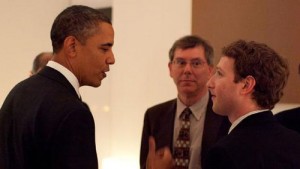
 Using the social platform Facebook, President Barack Obama argued for his plans for diminishing U.S. debts. The discussion between Facebook’s founder Mark Zuckerberg and White House chief was broadcast live on the social platform.
President Barack Obama criticized for the young audiences the Republican budget recovery plan designed by financial expert Paul Ryan. They intend to significantly reduce state spending on social projects, while democrats led by Obama want to raise taxes for the rich Americans.
“The budget presented by Republicans is not courageous but rather radical. I think Mr. Ryan is honest. I think that is a patriot. I think he wants to solve the problem that is our long-term budgetary deficit. At the same time I believe that Paul Ryan, along with other Republicans in the House of Representatives, are seeking to change our social system in a fundamental way”, said Barack Obama.
At a closer look, it is inferred that the importance lies not so much in the interview dialogue between Barack Obama and moderator Mark Zuckerberg. Important was the way of online communication. The true winner of the interview is basically the social platform Facebook, which has enjoyed significant advertising campaign. By having the President at the Facebook headquarters in Silicon Valley, the U.S. government recognizes the weight and the overall impact of social platform.
Mark Zuckerberg may rightly say that Facebook has played an important role in the overthrow from power of President Hosni Mubarak of Egypt, considering that the Facebook page “We are all Khaled Said” has led to the first mass demonstration in Tahrir market in Cairo. And when the site administrator, Wael Ghonin, was asked in an interview with CNN where the following riots will take place in the Arab world, Ghonin answered straight to the point: “Ask Facebook!”
Presidents and heads of state from around the world have realized in the meantime the growing importance of social platforms for political spheres. Russian President Dmitry Medvedev admitted after his election that he begins the working day searching for information on the Internet. Moreover, Medvedev has a blog on the Russian platform “Livejournal”.
French President Nicholas Sarkozy has already had in summer of 2005, as Minister of Interior at that time, an exclusive interview with a famous French blogger, Loic Le Meur. The interview was published online, and it registered a record number of visitors.
Only German politicians’ relationship with the Internet seems to be hesitant. A recent study with 750 German politicians proved that nearly 50% of them do not respond to emails and 45% are not present online.
President Barack Obama and his executive have recognized the importance of media platforms as a channel of communication with the younger generation. Obama concluded the round of talks with a request: “Regardless of political affiliation, you all must be involved in politics. You, young people, the new generation. If you do not give us a push down, if you do not give a new momentum to system, then nothing will change and eventually you’ll be the ones who will suffer the consequences. But if you put as much energy and imagination in the political process as you invest your time in Facebook, I assure you that no problem will remain unsolved”.