
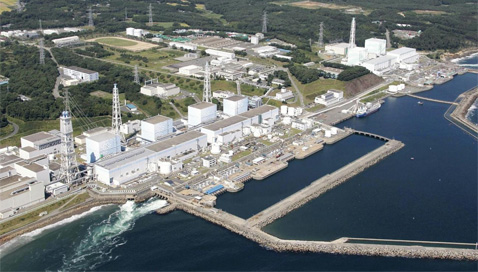
 The operator of the damaged Fukushima plant announced today that it discovered high levels of radioactive elements (strontium-90 and tritium) accumulated in the groundwater near the reactors.
The operator, Tokyo Electric Power (TEPCO), detected levels of 500,000 becquerels of tritium per liter of water and 1,000 becquerels of strontium-90 per liters of water in the liquid sampled near the building containing the turbine of the reactor number 2 of the nuclear complex, by the sea. Strontium-90, considered a high-risk carcinogen factor is a by-product of the fission of plutonium and uranium.
The tritium level measured (equivalent to 500 becquerels per cubic centimeter) is eight more higher than the safety standard set by the government for the sea water, and the level of strontium-90 (1 becquerel per cubic centimeter) is 30 times higher than the legal limit.
TEPCO announced Wednesday morning during a special press conference that there is a high probability that the high level of radioactive materials is caused by the meltdown following the March 2011 tsunami. The contaminated water is accumulated at the place where the sample was taken and it didn’t flow any further, according to TEPCO.
The operator of the Fukushima plant added that it continues to control the radiation levels and will adopt measures to avoid leaks of the contaminated water into the sea. The measurements show, for now, that there were no leaks in the Pacific Ocean nearby.
Fukushima Daiichi was ravaged by an earthquake followed by a tsunami on 11 March 2011, in the northeast of the Japanese archipelago. Power failure occurred in the chaos that followed the earthquake led to a halt of fuel cooling systems that melted in three of the six reactors at the plant.
Approximately 3,000 workers on site reveal little by little the extent of damage, making sure that the issues that frequently arise will not create and out-of-control situation.

Reply