
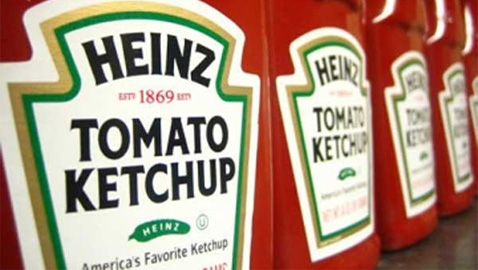
 The maker of Heinz ketchup will be acquired by Berkshire Hathaway, Warren Buffett’s company, and 3 G Capital in a $28-billion deal which includes the company’s debt. Heinz (NYSE:HNZ) shareholders will receive $72.50 per share of common stock, 20 percent over the $60.48 share price at the stock exchange close on Wednesday. The transaction will be financed with cash from Berkshire Hathaway and the affiliated companies of 3 G Capital, by rolling the existing debt and loans agreed with J.P. Morgan and Wells Fargo.
The famous bottle, an American emblem of the fast food launched in 1876, has conquered the world. It passed 650 million bottles sold in 2012. Heinz, a food processing company headquartered in Pittsburgh, Pennsylvania is a brand inseparable from its ketchup. Made in the USA, it is distributed in 200 countries. In United States, Heinz ketchup is first with a market share of over 50%. The emblematic bottle of tomato sauce is in the news today due to the spectacular takeover, for 28 billion dollars, by billionaire Warren Buffett.
The origins of ketchup are more modest. They seem to go back to the Asian sauce ‘ke-tsiap’. This spicy preparation, made from brine, was exported by the British sailors at the end of the 18th century. American were changing it by adding tomatoes, vinegar, and sugar in addition to salt. Fresh tomatoes were still considered by many as a poison in the 19th century: the sauce became popular in part because it allows to eat the tomato in a refined form.
In 1876, the businessman German origin, Henry John Heinz, launches its ketchup in Pittsburgh, Pennsylvania, which is still the global headquarters of the brand. It improves the recipe by adding more vinegar, and uses very ripe tomatoes. Adapting to the evolution of tastes and the laws, the ketchup bottle wins little by little its success. At the death of the founder in 1919, Heinz has more than twenty factories. Then comes the export. According to legend, the sauce landed in France in 1944 with the American soldiers. Heinz is yet present since 1886 in London.
The success of the brand has long relied on a single commodity, easily recognizable: the octagonal, glass bottle with the same logo on the label. The marketing associated to the bottle praise the texture of the sauce, recognizable for the slowness with which it flows. A slow considered by many its major flaw.

Reply