
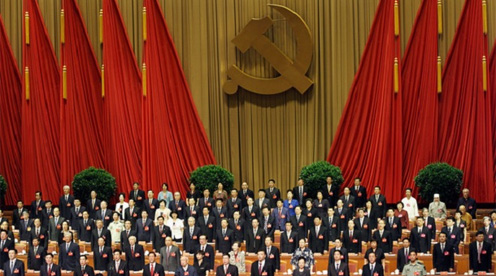
 Extreme security measures in place in Beijing: kitchen knives disappeared from the shelves, pigeons are locked in their cages and window opening devices were disabled for passengers in taxis, to prevent them surreptitiously transmit message of disapproval.
If all this looks like a paranoia, residents can take solace in the thought that it only happens once every ten years. Today, about 2,300 delegates from municipalities, autonomous regions and provinces across China gathered in Beijing, for the start of the 18th Congress of the Communist Party, at a time of management transfer, which takes place every ten years.
Expect few surprises at the top. Xi Jinping is to replace Hu Jintao as General Secretary of the party which leads China since 1949. Li Keqiang will succeed Wen Jiabao as premier. At the Congress a transition will be made from the current generation of technocrats to a new generation, the fifth, of leaders. Many are “red princelings”, the Communist equivalent of blue-blooded aristocracy. Xi Jinping’s father, Xi Zhongxun, was a revolutionary leader and former deputy prime minister.
But even if the party will present a united image at the congress, the last few weeks have witnessed some fierce battles for power between the ruling factions, especially between “princelings” and Communist Youth League officials (LTC), which is the base power of the President Hu.
The fifth generation of leaders will have to solve a lot of thorny issues. It inherits the most modest growth since 1999, estimated at 7.7% this year. It will also face growing discontent against land expropriations and corruption. Transition is made in the context of strained relations with Japan, because of territorial disputes over islands called Senkaku in Japan and Diaoyutai in China.
Analysts have divided opinions regarding the attitude of the new generation of leaders on the reform. Will they be more open or they will maintain their predecessors line? Hu Deping, son of late Communist Party chief Hu Yaobang, called on management to adopt change. “Reforms can not be wasted, promises should not not abandoned,” Hu wrote in the Economic Observer, saying that country’s current troubles may threaten development and hinder party’s ability to govern. He insisted: “We must create conditions to allow private companies to set up in monopoly industries, we should encourage fair competition to create and regulate open and fair markets “.
Steve Tsang, from the Chinese Policy Research Institute at the University of Nottingham, said that he doesn’t expect future management to implement democratic reforms, but expressed hope that the Congress will elect a strong leadership with the political will to restructure the economy. “The new team will be composed of ‘best people’ of the Chinese Communist Party. Those brave, as the term is understood in British politics, will not be too many. The same goes for the bold and visionary,” he said.
Delegates are representing many different interests in China, such as state enterprises, state banks, People’s Liberation Army and other government agencies. Their task will be to review the period since the last congress, and to elect the 200 members of the Central Committee which will appoint a Politburo consisting of 25 members and a Politburo Standing Committee, which is rumored to have seven members instead of nine, as it has now.
This year’s congress will see the resignation of three-quarters of senior management: 14 of the 25 Politburo members and seven of the nine members of the Politburo Standing Committee. Congress will close on or around November 14.
One of the “princelings” aimed at top-level but will not be attending the party congress is the former Chongqing chief, Bo Xilai, involved in the British businessman’s Neil Heywood death scandal. At the plenary this week, behind closed doors, the management decided to exclude Bo from the party, thereby opening the path for him to be prosecuted. Tsang said that Bo scandal will probably throw a shade, but will not have much impact, given that the party’s propaganda machine is working at full capacity and congress is directed with great care.

Reply