
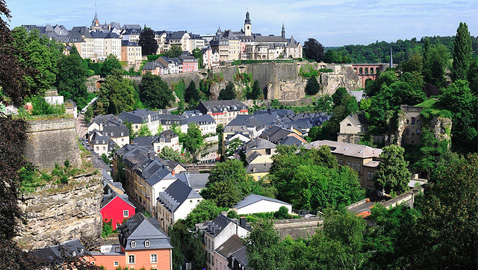
 The biggest tax haven in the European Union is Luxembourg, the country where money can be legally protected from the tax authorities.
Investors want full security for their money, big profits and low taxes, conditions offered not only in exotic islands but also in Europe.
“We don’t have to look to the Caribbean. We can also step outside our own front door,” said Reinhard Kilmer, a tax fraud investigator. According to him, United Kingdom protects the Channel Islands and the Isle of Man and France has Monaco. In addition, Europe has problems with Switzerland, Luxembourg and Austria. Yields may not be as high as in the Virgin Islands, but are extremely safe for deposits, says Kilmer.
The biggest tax haven of the European Community is Luxemburg, a founding member of the EU. But Luxembourg’s Finance Minister, Luc Frieden, rejects the idea that his country is a tax haven. “We are a European center of finance and do not encourage anyone to engage in tax evasion,” said Luc Frieden.
In the little country, 141 banks operate from 26 countries. For several decades, Luxembourg has earned a reputation of a safe fiscal oasis. The volume of investment funds amounted to about €2,100 billion ($2,730 billion), estimated the financial advisory office Ogier. These funds are virtually tax exempt. In order to protect the profits from the long arm of tax man, many international corporations have opened branches in the Grand Duchy. According to European legislation in force, the procedure is allowed. Money from abroad have made Luxembourg an European leader in income per capita.
Member of European Parliament Sven Giegold, financial expert of the Green Party demanded more transparency from corporations. “A company should have to make clear in its balance sheets how many subsidiaries it has, how much in profits it is earning and where as well as how much it’s paying in taxes,” said Giegold.
In an interview with the Frankfurter Allgemeine Zeitung, Minister Luc Frieden was willing to explore the possibility of automatically sending to tax authorities data on interest earned, but only to private investors’ countries. His statements were criticized in Luxembourg. “Banking secrecy must be kept,” asked the Democratic Party in Luxembourg.
EU is not in charge with the fiscal policy of each member state, and competition in tax rates is desired. For years, Europeans are trying to find a uniform basis of assessment, ie to determine what part of wealth or income should ne taxed. Experts believe that the approach is useless. Instead, transparency is needed especially considering possible financial storm in the European tax havens, in which case other member states could be called to take part in a rescue operation.
European partners have helped save with ten billion Cyprus. The overall value of the banks in the small island state was seven times higher than the country’s annual economic performance. In Luxembourg, this ratio is 22 times higher.

Reply