
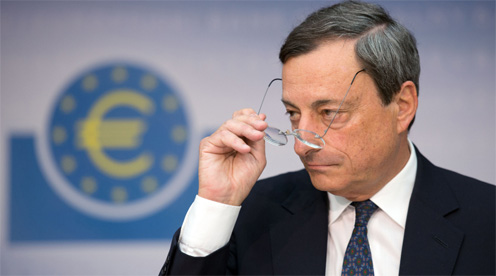
 The President of the European Central Bank admitted that the rise of the euro is a concern if it would influence the price stability and the eurozone would enter a deflationary cycle. The Central Bank does not target the exchange rate itself and its only concern is price stability. This is the official doctrine that Mario Draghi reiterated on Thursday, after the monthly meeting of the ECB.
But the stability of consumer prices should be understood in two ways. They do not increase too fast, which is obvious, but they also should not collapse. Clearly they do not deviate from the goal of 2% annual growth of consumer prices in Euroland.
Mario Draghi reiterated this second meaning of the word “stability.” He admitted that the ECB would consider the situation. “The appreciation of the euro changed our judgment insofar as price stability is concerned,” according to his own terms. This little phrase alerted the foreign exchange markets, which reacted by lowering the euro 1 percent to $1.34.
Is this on the same page with the direction of exchange rate policy that François Hollande expressed last Tuesday, during his testimony before the European Parliament? No. Asked about remarks of the President of the French Republic, Mario Draghi said: “We must never forget that the European Central Bank is independent.”
The ECB is clearly not ready to enter the “currency war”, a term that Draghi himself used, but to play down intentions of some of his counterparts, such as the Governor of the Bank of Japan. He cited the change of the inflation target (recently announced by the Bank of Japan), and also the previous announcement of the Federal Reserve to keep the interest rate low for a long period of time. Mario Draghi therefore considers that the decisions of its U.S. and Japanese counterparts are quite legitimate in itself. Everyone is master in his own kingdom.
However, he added that “if the effects are not consistent with the analysis of the G20, we should act.” In other words, if the monetary policies of major national palyers lead to exchange rates that do not reflect the fundamentals of national economies, heads of state or government who sit at the G20 will agree to correct the excesses.

Reply