
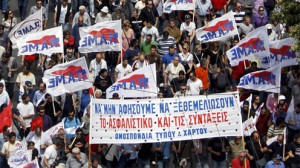
 Approximately 70,000 people manifested Wednesday in Athens, Thessaloniki and other cities, the first day of a general strike of 48 hours, after the unions call against a new series of austerity measures imposed by creditors of Greece in return for aid. In Athens, four different groups, totaling 52,000 people, according to police, marched through the streets of the capital heading towards Syntagma Square, in front of the Parliament, which began Tuesday night a debate on a draft law to impose a disputed new series of austerity measures.
This bill essentially provides the reducing number of government employees, suspension of collective agreements, and increasing the income tax on individuals.
The first group of pro-communist Workers’ Front (Pame), comprised approximately 10,000 people. This was followed by about 15,000 demonstrators from the trade union in the private sector and about 15,000 supporters of the radical left, according to the police press office. Shortly before 1:00 PM local time, the market where demonstrators have gathered was still full of people, announced an AFP photographer.
In Syntagma Square, by the Parliament, surrounded since Wednesday morning by police and anti-revolt forces, a rally was held attended by approximately 12,000 people. As a precaution, police closed two downtown underground subway stations, where it was held a rally attended by thousands of supporters of the Communist Party, before a huge rally set for Wednesday at lunch time. Around 3,000 policemen are stationed in the capital, a number that can be increased up to 5,000.
In Thessaloniki, the second most important city in the north, about 15,000 people manifested on the streets, while in Heraklion, on Crete Island, thousands participated in protests.
Wednesday, first day of the 48-hour strike, before Thursday night’s vote on the disputed bill, transport, schools, museums and public sector throughout Greece were paralyzed, while many shops, banks and kiosks were closed.
Clashes erupted Wednesday between youth groups and police located near the Greek parliament in central Athens. Approximately 200 young people started throwing Molotov cocktails and stones at the police barrier installed to block access to Parliament, generating a response with tear gas.
The two main trade union confederations in the country, GSEE, which represents the private sector, and Adedy, of the public officials have called the organization of demonstrations in Athens and Thessaloniki, starting at 8.00 GMT. But, according to police, about 20,000 demonstrators were already on the streets, in different places in the capital city since early morning.
There are very few professions that have not announced their intention to take part in protests which include government employees, tax authorities, doctors and teachers to sailors, taxi drivers, traders and owners of gas stations. Even bakers participating in the strike. Access to a large number of public buildings was blocked by government employees upset with the new measures announced, including sending in “technical unemployment” 30,000 of them by the end of the year, and the introduction of a unified salary.
“Take your memorandum and get out” could be read on a sign suspended at the entry of an institution under the Ministry of Health, in Athens, a reference to a plan in May 2010 of the EU and the IMF to save Greece from bankruptcy. In turn, air controllers have decided to participate in Wednesday’s strike for 12 hours, causing airlines to cancel or delay many flights.
[youtube]WIZcdcfIpy0[/youtube]