
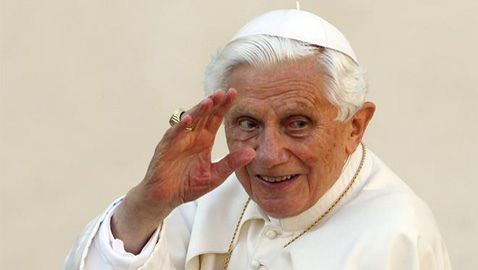
 Never-seen for six centuries, Pope Benedict resignation will be effective on February 28 and his successor will be elected in March. In explaining his decision, the pope cited a loss of “vigor of body and mind” in recent months.
Shock and disbelief on the outskirts of St. Peter’s Basilica in Rome. The supreme head of the Catholic Church, Pope Benedict XVI, Joseph Ratzinger, eighty-five years old, announced this morning, that he resigns for health reasons. It will be effective February 28 at 20:00. This is the first time in the modern history of the Church that a Pope decides of his own to relinquish the highest position in the Catholic Church, the latest case dating back to 1415, the date of (forced) resignation of Pope Gregory XII. Actually, the real historical precedent was rather the resignation of Pope Celestine V, on December 12, 1294, due to illness.
“I must confess my inability to properly administer the ministry entrusted to me.” This is the key phrase of Benedict XVI in the consistory where he announced his resignation citing imminent loss of “strength of body and mind” in recent months. “There is no disease that has affected the pope’s decision,” said the Vatican spokesman. According to most experts, deciding to shorten, on his own, the mission after seven years and nine months at the head of the Church, Joseph Ratzinger wants to avoid the syndrome at the end of chaotic rule of his predecessor, Jean Paul II, severely weakened by Parkinson’s disease during his last years. In fact, Benedict XVI became very weak from his last trip abroad, in Lebanon in September. In his book “Light of the World”, published in 2010, he mentioned the possibility of having to withdraw if he feels his “forces physical, mental or spiritual will be lost”
During his press conference, the Vatican spokesman, Father Federico Lombardi, said the election of his successor will take place in the first week of March, so that the Church has a “new pope for Easter”. Among possible successors, the name of Cardinal Angelo Scola, archbishop of Milan, very involved in the movement Communion and Liberation, is most often cited, although the name of Nigerian Cardinal Francis Arinze is also given as a potential favorite if a non-European would be chosen. The names of the Austrian Christoph Schönborn, sixty-seven years old, the Archbishop of Manila, Luis Antonio Tagle, and American Timothy Dolan are also circulating as possible replacements. Already in 2004, on the eve of his election, Joseph Ratzinger told a German television station that the time was now ripe for the election of a “pope of color.”
“It was a thunderbolt from a clear sky,” said Cardinal Angelo Sodano, dean of the College of Cardinals. For his part, the head of Italian government, Mario Monti, who has enjoyed the broad support of the Catholic world and the Vatican for his candidacy to lead the moderate forces in the elections of February 24, said he was “very shaken by this unexpected news.” A “revolutionary act” commented the leader of the centrist UDC, Pier Ferdinando Casini. The Vatican spokesman said the resignation is expressly provided for by the canonical law.

Reply