
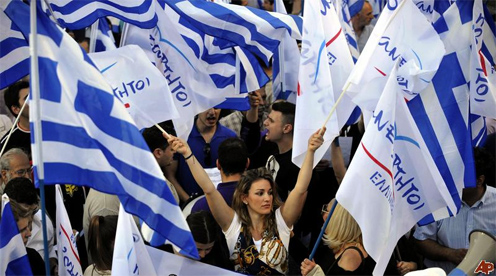
 Greeks return to the polls Sunday in the new general elections, monitored with anxiety across Europe and beyond, which takes the shape of a referendum vote for or against the euro, writes AFP. The consequences of this crucial election which, by contagion, could destabilize the euro area, will be weighed immediately after by rich and emerging powers during the G20 summit, which will take part on Monday and Tuesday in Los Cabos, southwestern Mexico.
All EU leaders and U.S. President Barack Obama warned the nine million Greek voters of the consequences of their vote for themselves, and for the euro area. “To be or not be in the euro area? This is the question,” said Greek Prime Minister Lucas Papademos, paraphrasing Hamlet, in Shakespeare’s tragedy, more than an ancient Greek tragedy, to summarize the “real dilemma” for Sunday. With just one day before the election, held after the inconclusive May 6 election, the right and left radical are fighting side by side to take the reins of a country in deep recession and social crisis, which became “the sick” of the European Union (EU).
Some polls show Antonis Samaras, aged 61, leader of the conservative New Democracy (ND) with a minimum advantage, in front of Alexis Tsipras, aged 37, leader of SYRIZA block, according to an expert. Showing a hesitant tendency hesitant on Friday, the Athens Stock Exchange Thursday recorded a jump of 10.1%, but without managing to recover from the fall recorded since May 6. Samaras presents itself as the guarantor of maintaining Greece in the euro area, while wanting to renegotiate the “memorandum” – the austerity plan negotiated with international lenders in exchange for financial aid. He emphasized on his campaign that “these elections’ stakes are clear: euro or drachma, coalition Government or non-government.”
Samaras, a conservative who is both nationalist and a politician that wants Greece in the eurozone did not exclude the possibility, if not getting a majority, to form a coalition with other right-wing parties, but also the socialists of PASOK. His left-wing rival, more charismatic but feared by the financial markets, says that it must put an end to the “memorandum” signed by the traditional parties” that were told what to do by the creditors. He offered himself a ten-day term after winning the election to have a “real and tough” renegotiation with the EU at the European summit that will be held in Brussels on 28 and 29 June.
“I hope that the parties will cooperate. That everyone will be united,” said Michalis Vlavianos, aged 77, who barely manages to live with a monthly pension of 630 euros.
Although Europeans, especially German Chancellor Angela Merkel, shown intransigence in messages addressed to Greece, Athens hopes more than ever at a margin of negotiations and to a support for economic growth. “The terms of compromise, to be signed by the end of September, will target a further delay of two years in the sanitation budget,” told AFP a former adviser to Papademos, who has run the country since May.
In two years, Greece was granted a massive aid totaling 347 billion euros – consisting of two loans, totaling 110 and respectively 130 billion dollars by 2015, but also a debt wipe out worth 107 billion euros – equivalent to one and a half its GDP.
Throwing the country into the fog, causing dismay in Europe and the suspension of the “temporary” payment of 2.6 billion euros of aid, the May 6 elections has not led to a majority or a coalition. Since then, Greece seems that they are on the brink of bankruptcy, and the financial numbers show a tough situation, namely a GDP down 6.5%, unemployment at 22.6%, a hemorrhage of bank deposits and public accounts that could be empty by mid-July.
The scenario of a possible exit of Greece from the euro area – a hypothesis rejected by 80% of Greeks – has become more insistent in European circles and world financial circles, after May 6. The last in a series, completed in early June by Deutsche Bank, provides details about what would mean the high risk period of time after stopping the payments “at the end of June or early July”: sessions of Parliament at the weekend, control over capital flows and withdrawals of bank deposits, restoring the role of the Bank of Greece, issuing a currency devalued by at least 50%.

Reply