
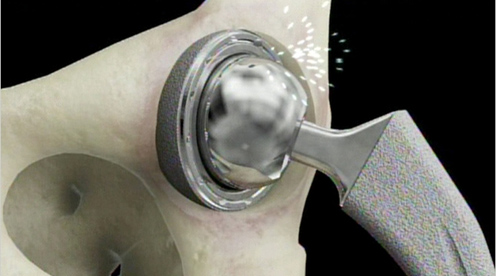
 Hundreds of thousands of patients worldwide could be exposed to high levels of toxic metals due to defective hip implants, whereas the risk was known, said Tuesday, following a joint investigation, British Medical Journal (BMJ) and the BBC. French daily Le Figaro writes that the ASR hip implants manufactured by DePuy orthopedics, subsidiary of U.S. company Johnson & Johnson, withdrawn from the Australian and U.S. market in 2009 continued to be sold in France until July 2010.
“ASR hip prostheses scandal would have passed almost unnoticed if U.S. giant Johnson & Johnson would not have put aside three billion dollars in an account for possible future lawsuits”, writes Le Figaro.
Hip prostheses and breast implants are medical devices and are not subject to the same constraints as drugs when placed on the market. The ASR implants have the particularity of a metal-metal joint, a pattern recognized as being more resistant than other ceramic-based materials, but has the disadvantage of releasing metal ions due to friction.
It was also shown that the need for new interventions is lower than in case of other prosthetic devices. BMJ shows that “there is nothing sure about the toxicity of metal ions in the body”, but suggests that such a level of uncertainty would not be acceptable for a drug. “Hip replacement is one of the great successes of modern medicine”, said Dr. Fiona Godlee, editor in chief at BMJ. “But the combination of poor regulations and an unlimited commercialism caused the actual harm to a large number of patients in the world”, she said. “They should be informed about the risks, as were manufacturers and regulators, but they were not told anything”, she lamented.
“Regulatory methods on medical devices seem to be from the 50s rather than from the twenty-first century”, said, in turn, Professor Nick Freemantle (University College London), quoted by BMJ.

Reply