
 Turkish government requested from Parliament authorization to conduct military operations in Syria. This aims primarily to deter Damascus to continue attacks against Turkey, which wants to avoid an escalation of the situation that could lead to a war with its neighbor, according to AFP.
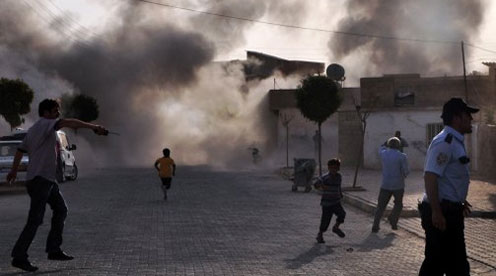
Barely digested the loss of one of its planes shot down in June by the Syrian air defense, the Syrian shell attacks Wednesday on the border village Akçakale, which caused the deaths of five civilians, triggered the retaliation of Ankara against the Syrian regime.
“It’s a very serious incident which exceeds any limit,” said Wednesday night after the bombing, Deputy Prime Minister Besir Atalay, to summarize his country’s exasperation.
Therefore, the Turkish army intervened and bombed sporadically, starting Wednesday, Syrian army positions around the border station Tall al-Abyad. Prime Minister Recep Tayyip Erdogan called from Assembly the official authorization to order an intervention of Turkish troops in Syrian territory.
“What has happened has the potential to escalate into an international conflict. We have to see what will happen in NATO and if the Turkish Parliament will give the government a mandate to launch operations in Syria”, said Riad Kahwaji, from the Institute of military analysis for the Middle East and the Persian Gulf (Inegma).
But according to his collaborators, Turkish Prime Minister does not intend to play the card of military escalation. “It is about discouraging, Turkey will not go to war,” he told AFP a source close to the government, “but these attacks can not continue”.
Also, several officials from the ruling Justice and Development Party (AKP) rejected the belligerent rhetoric expressed Thursday by some Turkish media headlines.
“Turkey does not seek to start the war but is perfectly able to defend itself from any attack that threatens its sovereignty,” said one of the party’s officials, Omer Celik.
“All military targets were bombed at night in a deterrent way,” said another party official and close aide to the Prime Minister, Yalcin Akdogan. “They got a lesson,” he added, “Now everything will depend on the attitude of Syria”.
Since the beginning of hostilities in Syria in March 2011, Turkish public opinion, already facing nearly for 30 years Kurdish separatist rebellion, in its great majority opposes intervention in Syria.
A survey released Thursday by the largest circulation daily newspaper Hürriyet confirmed that 62 percent of Turks oppose the text discussed and approved on Thursday by Parliament. Although it consolidated its presence on the border with Syria in recent months, the Turkish army remained cautious so far.
“It’s mainly to show that the army is able to intervene at any time but this does not mean that it will go to war,” concluded retired General Armagan Kuloglu for private television station NTV.

Reply